by Jen Miller
Learning to sail can seem like a daunting process. Besides just learning how to sail a boat, the terminology of boating is completely different, and most of what needs to be learned can only be acquired by doing, meaning practice is required. But before you head out on the water, you can increase your knowledge by reading up on sailing, which will further help to keep you safe while on your boat.
Learning to sail can seem like a daunting process. Besides just learning how to sail a boat, the terminology of boating is completely different, and most of what needs to be learned can only be acquired by doing, meaning practice is required. But before you head out on the water, you can increase your knowledge by reading up on sailing, which will further help to keep you safe while on your boat.

Sailing Defined
Sailing is the art of taking a boat, turning off the motor, and harnessing the power of the wind to make the boat go where you want it to go. It might seem difficult, but it is really very simple, provided you take the time to understand how the boat utilizes the power of the wind. More than likely your boat will also have a motor (for times when there is no wind), but we will mainly focus on the actual process of sailing, and how that can be achieved.
Before you leave the dock
Before you head out on your own boat (or before you go to purchase a boat), search online and find the nearest sailing school or yacht club. You can find the local sailing school where you can take one on one sailing lessons, or even take an instructor out on your boat to show you the ropes, and how to safely sail. There are also free classes you can take online, which can better prepare you in learning the basics of sailing.
Make sure and check the weather before heading out. If there is a storm headed your way, or in the direction you want to go, it might be prudent to wait a few days until calmer weather is in the forecast. It also can be quite boring to head out on the water if there is no wind, as you will be forced to motor the entire time.
Dress for the weather, but be sure and bring lots of layers. Even if it’s hot out, while out on the water there is nothing to shield the wind, so it might seem colder than on land. Always have a jacket, hat, sunscreen, long pants and or shorts, shoes, and bring lots of water and snacks. Better to be over prepared than under prepared.
Make a Checklist
Make a checklist for necessary equipment you will want to bring with you on the boat (or even things that are US Coast Guard required). This could include items such as:
These are all useful and necessary items to have stocked on your boat: some are required by the Coast Guard, and some are just common sense. It might also be helpful to bring a sailing buddy when you head out, to assist with docking, hoisting the sails, or just giving a second opinion in case something should occur.
Know your boat
Before heading out on the water, make sure and inspect as much of your boat as you can: understand where the lines (ropes) are going, how the sails are hoisted (lifted) and lowered, and where the safe places to walk or sit will be once you are out on the water. This article will discuss the basic terminology (with important words defined in bold), and try to explain as much as you need to know about the basic parts of your sailboat.
Let’s start with the simple terminology first.
When you get on your boat, and are facing towards the front of the boat, that would be forward, with everything behind you being aft. The very front of the boat is the bow, with the aft part of your boat called the stern. The left of the boat is the port side (think left and port both having four letters), with the right side being the starboard side. That seems simple, right? So let’s keep going.
The mast is the vertical pole the supports the sail. If you only have one big sail, there will only be one mast. Some boats have more than one mast, but sailboats always have at least one. The horizontal pole that comes off the bottom part of the mast is called the boom (which is also the sound it makes when it hits you in your head… be careful of this one!). The tiller is a horizontal lever arm that turns the rudder (steers the boat), and is either by itself or is attached to the wheel, which is what you use to steer the boat. Standing in the boat you will be on the deck, but if you go inside the boat you will be below-deck. The sides of the boat are called the hull, and the draft is the distance from the surface of the water to the deepest part of the boat under water (important to know if you don’t want to run aground).
The lines that hold up the mast on the starboard and port sides up to the top of the mast are called the shrouds, while the wire that runs from the mast to the stern is called the backstay, and the wire that runs from the mast to the bow is the forestay (also called the headstay). The beam is the width at the widest point of your boat, and the total length overall is the horizontal length from the tip of the stern to the tip of the bow (necessary to know depending on where you want to dock or store your boat).
It may seem like quite a few terms to know, but while being on a sailboat everything is called something different. But we are only concerned with the most important terms at the moment.
When you start putting up a sail, you will be pulling on a halyard. If you are putting up the mainsail (largest sail that is attached to the mast), you will be pulling on the main halyard. To let the sail move towards the starboard or port side of the boat, you will let out the main sheet (line that is attached to the bottom aft section of each sail, which moves it side to side). You may need to use a winch, which is a round drum that increases your power capabilities to pull on a line (rope).
Check out this video where someone demonstrates on a boat all the different parts of a sailboat:
Sailing is the art of taking a boat, turning off the motor, and harnessing the power of the wind to make the boat go where you want it to go. It might seem difficult, but it is really very simple, provided you take the time to understand how the boat utilizes the power of the wind. More than likely your boat will also have a motor (for times when there is no wind), but we will mainly focus on the actual process of sailing, and how that can be achieved.
Before you leave the dock
Before you head out on your own boat (or before you go to purchase a boat), search online and find the nearest sailing school or yacht club. You can find the local sailing school where you can take one on one sailing lessons, or even take an instructor out on your boat to show you the ropes, and how to safely sail. There are also free classes you can take online, which can better prepare you in learning the basics of sailing.
Make sure and check the weather before heading out. If there is a storm headed your way, or in the direction you want to go, it might be prudent to wait a few days until calmer weather is in the forecast. It also can be quite boring to head out on the water if there is no wind, as you will be forced to motor the entire time.
Dress for the weather, but be sure and bring lots of layers. Even if it’s hot out, while out on the water there is nothing to shield the wind, so it might seem colder than on land. Always have a jacket, hat, sunscreen, long pants and or shorts, shoes, and bring lots of water and snacks. Better to be over prepared than under prepared.
Make a Checklist
Make a checklist for necessary equipment you will want to bring with you on the boat (or even things that are US Coast Guard required). This could include items such as:
- Life Jackets
- Drinking water and snacks
- Sunscreen
- Sunglasses, hat, jackets, extra clothing
- Engine fuel and spare parts
- Binoculars
- Chart (handheld GPS as well)
- Bucket (can be used to bail water, clean off the boat, or as a restroom if need be)
- USCG required equipment for the boat
- Sound signals (whistle or fog horn)
- Fire extinguisher
- Visual distress signals (flares or flashlight at night)
- Navigation lights (required at night, or if visibility is reduced)
- Anchor and chain/line
- Extra line (mooring or various other uses)
- Fenders (Plastic hard ‘balloons’ that keep your boat from bumping on the dock)
- VHF radio and cellphone
- First-Aid Kit and booklet
- Tool Kit and Knife
- Lifesling or throwable buoy
- Bilge pump
- Radar reflector
- Ditch kit (full of life saving necessities in case you have to abandon ship)
- Life raft of some sort (depending on where you are sailing, and the size of your vessel)
These are all useful and necessary items to have stocked on your boat: some are required by the Coast Guard, and some are just common sense. It might also be helpful to bring a sailing buddy when you head out, to assist with docking, hoisting the sails, or just giving a second opinion in case something should occur.
Know your boat
Before heading out on the water, make sure and inspect as much of your boat as you can: understand where the lines (ropes) are going, how the sails are hoisted (lifted) and lowered, and where the safe places to walk or sit will be once you are out on the water. This article will discuss the basic terminology (with important words defined in bold), and try to explain as much as you need to know about the basic parts of your sailboat.
Let’s start with the simple terminology first.
When you get on your boat, and are facing towards the front of the boat, that would be forward, with everything behind you being aft. The very front of the boat is the bow, with the aft part of your boat called the stern. The left of the boat is the port side (think left and port both having four letters), with the right side being the starboard side. That seems simple, right? So let’s keep going.
The mast is the vertical pole the supports the sail. If you only have one big sail, there will only be one mast. Some boats have more than one mast, but sailboats always have at least one. The horizontal pole that comes off the bottom part of the mast is called the boom (which is also the sound it makes when it hits you in your head… be careful of this one!). The tiller is a horizontal lever arm that turns the rudder (steers the boat), and is either by itself or is attached to the wheel, which is what you use to steer the boat. Standing in the boat you will be on the deck, but if you go inside the boat you will be below-deck. The sides of the boat are called the hull, and the draft is the distance from the surface of the water to the deepest part of the boat under water (important to know if you don’t want to run aground).
The lines that hold up the mast on the starboard and port sides up to the top of the mast are called the shrouds, while the wire that runs from the mast to the stern is called the backstay, and the wire that runs from the mast to the bow is the forestay (also called the headstay). The beam is the width at the widest point of your boat, and the total length overall is the horizontal length from the tip of the stern to the tip of the bow (necessary to know depending on where you want to dock or store your boat).
It may seem like quite a few terms to know, but while being on a sailboat everything is called something different. But we are only concerned with the most important terms at the moment.
When you start putting up a sail, you will be pulling on a halyard. If you are putting up the mainsail (largest sail that is attached to the mast), you will be pulling on the main halyard. To let the sail move towards the starboard or port side of the boat, you will let out the main sheet (line that is attached to the bottom aft section of each sail, which moves it side to side). You may need to use a winch, which is a round drum that increases your power capabilities to pull on a line (rope).
Check out this video where someone demonstrates on a boat all the different parts of a sailboat:
Now that we have discussed the basic parts of the boat, let’s leave the dock and head out on the water to set the sails!
Leaving the dock
It is possible to sail off of a dock, or a mooring ball, but usually that takes a bit more practice. For the beginner it’s best to start up the engine, and wait to set the sails until you have the space to work on doing it correctly. If you are at the dock, look around and know what’s around you. You should be aware of where the wind is coming from; even with the sails down the mast is a sail in itself, and the wind will tend to push you once you untie your lines from the dock. This can help you get off the dock, but it can also push you into another (probably more expensive) boat, or even another dock.
Make sure you don’t have any lines dragging in the water, or anything that can get twisted up and foul the prop. Leave at least one line on the dock to help guide you out, and then untie that last line when you know you won’t hit anything else on your way out. Remember to steer the boat slowly, things tend to happen quickly, even at slow speeds. Take turns wide until you are out of the marina, and watch out for boats that are heading in.
Check out this video from the Maryland School of Sailing and Seamanship, as they teach you how to properly dock a sailboat:
Leaving the dock
It is possible to sail off of a dock, or a mooring ball, but usually that takes a bit more practice. For the beginner it’s best to start up the engine, and wait to set the sails until you have the space to work on doing it correctly. If you are at the dock, look around and know what’s around you. You should be aware of where the wind is coming from; even with the sails down the mast is a sail in itself, and the wind will tend to push you once you untie your lines from the dock. This can help you get off the dock, but it can also push you into another (probably more expensive) boat, or even another dock.
Make sure you don’t have any lines dragging in the water, or anything that can get twisted up and foul the prop. Leave at least one line on the dock to help guide you out, and then untie that last line when you know you won’t hit anything else on your way out. Remember to steer the boat slowly, things tend to happen quickly, even at slow speeds. Take turns wide until you are out of the marina, and watch out for boats that are heading in.
Check out this video from the Maryland School of Sailing and Seamanship, as they teach you how to properly dock a sailboat:
Don’t Run Aground!
If you have sailed for any time at all, you will eventually run aground (it happens to the best of us). But you want to avoid this at all costs, so there are a few things you should think about as you head out of the marina.
If you do run aground, try not to panic! Here are some steps to work through to get your boat back out into deeper water.
Let’s Get to Sailing
Now that you are in your boat out on the water, find a calm uncrowded area to start sailing. This may mean you head out in the center of the lake, or perhaps you have to motor for a few minutes to get away from the local boat traffic, but having some space while you figure out your sails will make all the difference.
Time to put the sails up!
How to Use the Wind to Sail
As already mentioned, sailboats can’t sail directly into the wind. In fact, there is a handy diagram that has been made that describes the ‘points of sail’ as the face of a clock. At the top of the clock, from about 10:30 to 1:30, is the no-sail zone. It is physically impossible to sail a boat in this zone.
If you have sailed for any time at all, you will eventually run aground (it happens to the best of us). But you want to avoid this at all costs, so there are a few things you should think about as you head out of the marina.
- Make you sure know what the draft is on your boat. There is a big difference between a 4 foot and 6 foot draft.
- Turn on your depth finder! It is also good to know where your depth finder sensor is located on the hull. If it’s under the stern, you might run the bow aground before the depth finder displays that it’s too shallow.
- Know how to read or follow the charts. Depths at low tide are recorded on marine charts.
- Understand the channel markers. The markers are there for a reason; sometimes right outside of the channel the depth is only a foot or less.
If you do run aground, try not to panic! Here are some steps to work through to get your boat back out into deeper water.
- Immediately stop your engine (and drop your sails if they are up), and then put the engine in reverse. If you have just barely run aground, the engine might be able to push you back off the low point, and you can feel lucky that it wasn’t worse. If not, access your situation before going further.
- Depending on where you have run aground, and where the wind is coming from, you might be able to raise your mainsail and use the wind to push you off the bottom. If the shallow area is on your starboard, and the wind is coming from the port side, when you raise the mainsail the wind will push the boat over on its starboard side. That means that the keel (part of the hull underwater that sticks down), will go in the opposite direction, hopefully decreasing the boat’s draft by tipping the boat onto its side. At this point you might be able to sail off the bottom, or simply use the engine to slowly push the boat off the hard (bottom).
- Use the anchor: get in your dinghy (inflatable or hard smaller boat that you pull behind your sailboat), and load the anchor and as much chain/line as you can safely pull in your boat. Then drive your dinghy out into deeper waters, and drop the anchor over the side. Wait a few minutes, and then slowly use the windlass (electric or hand-operated machine that pulls up the anchor chain into the boat) on your sailboat to pull the boat out of the shallows. This maneuver might need to be repeated several times, depending on how good the anchor is stuck into the ground, and how far your sailboat will travel before the anchor gets pulled up.
- Look around for fellow boaters. Perhaps someone nearby might feel pity on you, and come and tow you off of the shallow area. Never hurts to ask!
Let’s Get to Sailing
Now that you are in your boat out on the water, find a calm uncrowded area to start sailing. This may mean you head out in the center of the lake, or perhaps you have to motor for a few minutes to get away from the local boat traffic, but having some space while you figure out your sails will make all the difference.
Time to put the sails up!
- Point the bow of your boat into the wind before putting the sails up. No, you cannot actually sail into the wind, but if you want to put the sail up without fighting the wind pushing on the sail and halting your progress, you will heed this advice.
- Take your sail cover off the mainsail, and take off any lines that were tied around the sail to keep it in place. Find your halyard, and start pulling on the line. The mainsail should start going up the mast. Keep eyes on the lazy jacks, which are the lines running from the top of the mast to about the middle of the boom. Make sure the mainsail is pulled up between these lines, and is not getting caught on any part of the lazy jacks.
- If the sail is getting too hard to pull up, you might need to use a winch to assist you. Wrap the halyard around the winch several times, and then use the hand crank to turn the winch and pull up the rest of the sail. Make sure you make fast (stop) the line before you walk away to do something else.
- Depending on where the wind is coming from, you will probably want to slowly let out the sheet, so the sail can fill with wind and push the boat forward. If the wind is coming from the port side, you will end up sailing to the right, and vice versa.
- Now it’s time to hoist the jib! It’s easier to hoist the jib while running downwind (wind at your back), if only because it will keep the sail from flapping against the mast while it is being raised. Either way, make sure the sheet is loose, so the sail will not fill with air, making it difficult to raise up completely.
- The sail will luff (flapping motion the sail makes when it is getting blown about by the wind), so don’t worry: that’s normal.
- Once the jib is up, now you need to figure out in which direction you can sail.
How to Use the Wind to Sail
As already mentioned, sailboats can’t sail directly into the wind. In fact, there is a handy diagram that has been made that describes the ‘points of sail’ as the face of a clock. At the top of the clock, from about 10:30 to 1:30, is the no-sail zone. It is physically impossible to sail a boat in this zone.
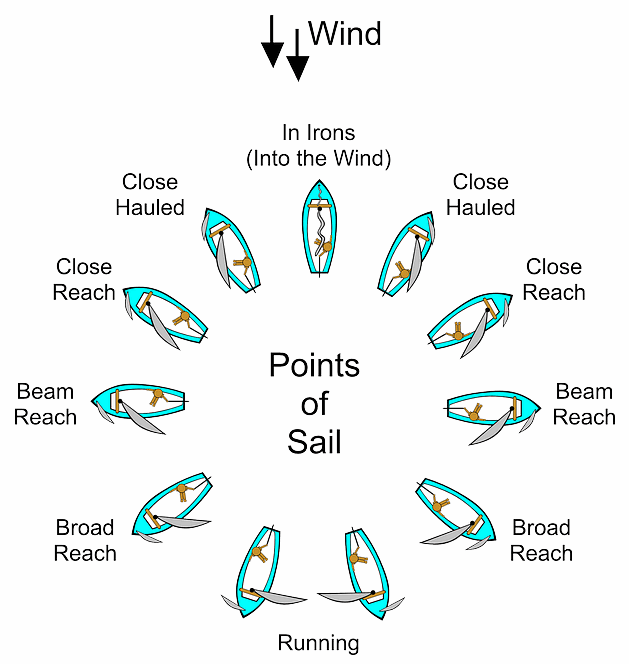
The zones where you can sail can further be divided into three basic points of sail.
- Close-hauled: This is the closest to the wind that you can sail efficiently. This would be right around 10:30 and 1:30 on the diagram.
- Reaching: Anywhere between close-hauled and running.
- Running: The course you steer when the wind is dead at your back (6:00).
Tacking and Jibing
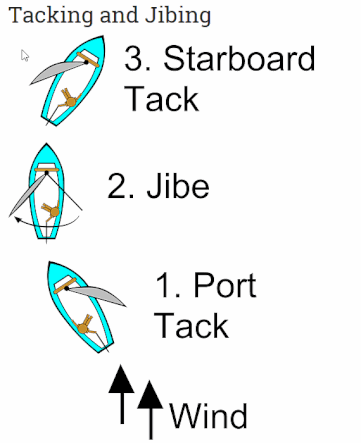
Tacking and jibing are simply the way to get a sailboat to turn a different direction. Which direction you turn based on where the wind is coming from is what makes the difference. Tacking is turning the bow through the wind so the wind will be on the opposite site. Jibing is turning the stern of the boat through the wind so the wind will be on the other side. Jibing is generally more dangerous, as the boom will shift sides during a jibe. But let’s discuss the process of each a bit more.
Tacking
Tacking is necessary when you are headed one direction, but you need to turn to go in another direction. So you will need to sail through the no-sail zone (refer to points of sail). This can be done very simply, but also safely is you follow these basic steps.
Tacking is very straightforward, and is perhaps the easiest way to turn under sail. Jibing is a bit more complicated, but can be achieved and accomplished simply with some practice.
Jibing
Jibing is a way to change directions by turning away from the wind, or turning the stern of the boat through the wind to change directions. When you are sailing downwind (on the points of sail diagram), jibing should technically be easier than tacking, because there is no ‘no sail’ zone to get stuck in. But it is also quite a bit more dangerous, because of the force behind the boom as it swings over your head. If you are on a broad reach, the main sheet will be let out, meaning the boom will be hanging out over the side of the boat. When you jibe, the boom will travel all the way across the cockpit to the other side of the water, sometimes very quickly. Ready? It’s time to learn how to jibe.
If it is an extremely windy day, you might want to change tacks without jibing. Jibing puts a lot of strain on the main as it swings across, which can be quite dangerous as well as hard on the sail and other equipment. Consider turning towards the wind, tacking around, and then heading down until you get to your desired course. It might take longer, but it will be safer for everyone on the boat, as well as for the boat itself.
Safety on the water
Now that you understand the better points of how to sail, you should think about how to sail safely. Things can happen quickly, with lines coming across the decks at high speeds, or having tension on lines when you need to adjust the sails. Here are some handy tips for how to maintain safety while sailing.
Sometimes sailing safely can be simply thinking ahead and not putting yourself in a situation that can prove to be too much for your skill level.
The following are some tips to think about when plotting a course for your next sailing adventure.
When it’s too windy
The wind doesn’t always blow exactly how you want it to, so sometimes you need to decrease your sail area so you can sail safely. But how can you do that? You can either drop one of your sails (either the main or the jib, depending on which is bigger), or you can reef (make smaller) a sail. Reefing a sail can seem a bit tricky, but once you understand the concept and do it a few times, it becomes old hat.
How to reef a sail depends on the type of sail you are trying to reef. If you have a roller furling jib, you might be able to roll it in part way, which could decrease your sail area by half. If you have a standard jib or mainsail, there are a series of steps you need to follow to properly reef the sail. Reefing a sail is much easier accomplished when the sail is not set (still on the boom), so make sure and follow these steps before you hoist the sail up.
Knots
Learning how to tie basic sailing knots is not only a beloved pastime for many sailors, but it can save your life if done correctly or it can result in broken equipment if done wrong. You can learn to tie knots in many books, one of which is Book of Sailing Knots.
The following is a list of knots you should learn to tie, with their designated use. Check out the following video to watch someone tie these knots:
Tacking and jibing are simply the way to get a sailboat to turn a different direction. Which direction you turn based on where the wind is coming from is what makes the difference. Tacking is turning the bow through the wind so the wind will be on the opposite site. Jibing is turning the stern of the boat through the wind so the wind will be on the other side. Jibing is generally more dangerous, as the boom will shift sides during a jibe. But let’s discuss the process of each a bit more.
Tacking
Tacking is necessary when you are headed one direction, but you need to turn to go in another direction. So you will need to sail through the no-sail zone (refer to points of sail). This can be done very simply, but also safely is you follow these basic steps.
- Prepare everyone on the boat by announcing that you are about to tack.
- Tighten up the sheets and get ready to turn.
- Call out ‘tacking’ and begin turning the boat towards the wind.
- As you begin to tack, the jib will start to luff: do not be concerned, this is normal. At this point, tighten up the jib sheet if there is any slack in it.
- As you turn and sail through the ‘no sail’ zone, slack the jib sheet and take up the sheet on the other side.
- You may need to duck under the boom if it moves as well, be cautious!
- Once the jib fills with wind again, stop turning, and trim (adjust) the sails as need be.
- Don’t stop turning when you are in the no sail zone, or you might lose momentum and have to start the motor to continue your turn.
Tacking is very straightforward, and is perhaps the easiest way to turn under sail. Jibing is a bit more complicated, but can be achieved and accomplished simply with some practice.
Jibing
Jibing is a way to change directions by turning away from the wind, or turning the stern of the boat through the wind to change directions. When you are sailing downwind (on the points of sail diagram), jibing should technically be easier than tacking, because there is no ‘no sail’ zone to get stuck in. But it is also quite a bit more dangerous, because of the force behind the boom as it swings over your head. If you are on a broad reach, the main sheet will be let out, meaning the boom will be hanging out over the side of the boat. When you jibe, the boom will travel all the way across the cockpit to the other side of the water, sometimes very quickly. Ready? It’s time to learn how to jibe.
- Let everyone on the boat know you are about to jibe by yelling, “ready to jibe!” This is to remind them to duck as the boom swings overhead… sometimes it happens faster than you realize.
- Call out ‘Jibe Ho’ and start steering the boat away from the wind, at the same time that you begin taking up on the main sheet and pulling the main to the other side. The more you can pull before the boom swings over, the less speed the boom will attain as it swings over.
- You do not need to turn quickly, as you will have the wind during the entire turn. As you turn past being dead downwind, the mainsail will jibe to the other side.
- Stop steering at this point, and trim the sails. You may need to tighten up on the sheets, or rather let some more line out.
If it is an extremely windy day, you might want to change tacks without jibing. Jibing puts a lot of strain on the main as it swings across, which can be quite dangerous as well as hard on the sail and other equipment. Consider turning towards the wind, tacking around, and then heading down until you get to your desired course. It might take longer, but it will be safer for everyone on the boat, as well as for the boat itself.
Safety on the water
Now that you understand the better points of how to sail, you should think about how to sail safely. Things can happen quickly, with lines coming across the decks at high speeds, or having tension on lines when you need to adjust the sails. Here are some handy tips for how to maintain safety while sailing.
- Pay attention to where your crew is at all times. When tacking and jibing, crew can easily be struck by the boom, or tangled in a line and injured. Make sure everyone is aware when you are changing directions, so they can assist and stay out of harms’ way.
- When you need to adjust a line on a winch that is under a lot of strain, be careful! You could end up burning your hands on the line, or even losing a finger if a ring gets caught. Be extra careful if you are wearing gloves, as they can get caught up in the line as it spools out. To ease a line out, hold the line with one hand, and put the other hand on top of the wraps on the winch. Slowly let the line out, keeping pressure on the winch so that the line doesn’t get out of control as it feeds out.
- Always pay attention to where lines are coiled up on the deck. Never step in a bight (loop of line), as you could get caught if the line suddenly was pulled tight. Always be aware of where you are stepping, and keep lines off the deck if possible and in a safe place.
- Always wear a life jacket: it might seem that it’s not necessary, but if you were knocked overboard while jibing you would want to be wearing one.
- Always know what to do in an emergency before an emergency happens. Practice man overboard drills by throwing a life jacket overboard and retrieving it. Know what to do when the bilge alarm goes off, or if the engine dies at the worst possible time.
- Have a generator on board in case you need to recharge the trolling motor batteries because the alternator isn’t operating correctly (it happens…). Or perhaps you want to run the air conditioner while you are out on anchor somewhere: an equally useful thing to have on board.
Sometimes sailing safely can be simply thinking ahead and not putting yourself in a situation that can prove to be too much for your skill level.
The following are some tips to think about when plotting a course for your next sailing adventure.
- Think ahead to where you will be sailing, and what obstacles will be in that general area. Try to pick a good course for the weather that might be coming. If there is heavy weather coming, try to sail to leeward (side that is protected from the wind) of an island, where you will be protected from the wind.
- Avoid shallow water. In storms waves tend to build in shallow water, because there is nowhere for them to disperse. It is also harder to see reefs and shallow spots during storms, as there are waves everywhere, not just on the reefs.
- Avoid sailing upwind during heavy waves, meaning that you will end up sailing up and over wave after wave. If the waves are really large and the winds are strong, you can actually end up sailing backwards, or simply making no ground at all in a storm.
- Avoid a lee shore. If you are sailing on the windward (side from which the wind is coming from) side of an island, the shore the wind is blowing on is the lee shore. If you sail with the wind blowing you towards the island, and something happens and you can’t sail away from the island, you will be blown by the wind onto the beach, or worse: rocks.
- Watch out for jibing accidentally. This can be very dangerous in high winds. Be careful never to let the wind get right behind you, as this could result in an accidental jibe. Waves can easily move you 10 or even 20 degrees as you move down a wave, so be careful to keep the boat on a broad reach in heavy seas.
- Be careful when heeling (boat leaning) over while sailing. If you heel over too far, anything unsecured might fall and make a mess inside the boat. It might also be a bit unnerving the first few times you heel over and the rail (edge of the boat deck) goes into the water. Sailboats are made for that; water drains easily over the side, just be cautious until you are comfortable doing it.
When it’s too windy
The wind doesn’t always blow exactly how you want it to, so sometimes you need to decrease your sail area so you can sail safely. But how can you do that? You can either drop one of your sails (either the main or the jib, depending on which is bigger), or you can reef (make smaller) a sail. Reefing a sail can seem a bit tricky, but once you understand the concept and do it a few times, it becomes old hat.
How to reef a sail depends on the type of sail you are trying to reef. If you have a roller furling jib, you might be able to roll it in part way, which could decrease your sail area by half. If you have a standard jib or mainsail, there are a series of steps you need to follow to properly reef the sail. Reefing a sail is much easier accomplished when the sail is not set (still on the boom), so make sure and follow these steps before you hoist the sail up.
- Make sure and rig up the reef line. The reef line runs from the leech (diagonal part of the mainsail), down to the boom, and is normally tied up on a cleat on the boom near the mast. This line should be made tight as this line of reef points (horizontal reinforced holes with lines tied through them on the mainsail) will now be the new foot (bottom) of the sail.
- Use a line to tie the tack cringle (forward most reef point) to the tack horn (area at the forward bottom corner of the sail, where the boom and mast meet). This will secure the sail to the boom, and keep it from riding up the mast by accident.
- Go along the sail, and reach above the boom, but below the sail and pull the opposite end of a reef point through. Then tie a reef knot with the two ends (knots will be explained later on). Continue along the sail and tie all the remaining reef points with reef knots.
- Now you can raise the sail! The sail area will be decreased, allowing you to continue sailing even in strong winds. And if the winds do die down, you can simply shake out (untie) the reef points, and untie the tack cringle and reefing line, then hoist the sail up to its full potential.
Knots
Learning how to tie basic sailing knots is not only a beloved pastime for many sailors, but it can save your life if done correctly or it can result in broken equipment if done wrong. You can learn to tie knots in many books, one of which is Book of Sailing Knots.
The following is a list of knots you should learn to tie, with their designated use. Check out the following video to watch someone tie these knots:
- Figure Eight: This knot is incredibly easy to tie, and is commonly used as a stopper knot at the end of a line. It can be untied even when a line is wet.
- Reef knot: This type of knot is used when reefing a sail. It is extremely simple to tie, and can be untied quickly if the reef needs to be shaken out.
- Square knot: A square knot is just two overhand knots tied with the first being right over left, and the second left over right. Square knots are used to tie two pieces of the same type of line together.
- Clove Hitch: A clove hitch is a way of tying a line around something, such as a lifeline or a piling. It is extremely useful on a sailboat.
- Sheet Bend: This knot is used to tie two pieces of line together, where one piece of line is of a smaller diameter than the other one.
- Bowline: this is probably one of the most useful knots to know. It is used to tie a loop in the end of a line, but can also be taken apart even when there is tension on the line.
- Rolling hitch: This line can be used to tie one line to another line, where it can grip the line and take the load off of the first line.
- Round turn and two half hitches: it is two overhand knots tied around anything: a pole or even the mast. It can be used when tying a quick knot to something, where you might need to untie it in a hurry, even if it is under strain.
- Fisherman’s Bend/Anchor bend: This knot is less likely than a bowline to loosen, but can be difficult to untie. It is the perfect knot to use when you want to leave it in place for a long time (such as to attach the anchor chain to an anchor).
There are a multitude of other knots to learn, but those are the basics. You can also learn how to splice (join two lines together), but that is not for the novice sailor.
Check out sailing books such as "How to Sail: An Introduction to Sailing for Beginners," and "Sailing for Dummies."
Conclusion
Learning to sail is definitely an adventure, but one that is worth undertaking. But be mindful of how you set about learning: read some books and take some sailing classes before heading out. Bring a friend who has sailed before to give you some pointers on your first few times out, and don’t be afraid to ask questions. Learn more about your boat, and understand how the sails work, and are raised and lowered. Practice tacking and jibing in a large non-busy area, so you can take your time and not feel stressed. And above all, be mindful of safety. Think before you act, and try to think about what you would do before situations occur. But don’t forget to have fun, and enjoy being out on the water!
As Mark Twain wisely said, “Twenty years from now, you will be more disappointed by the things you didn’t do than those you did. So throw off the bowlines. Sail away from safe harbor. Catch the wind in your sails. Explore. Dream. Discover.
About the Author: Jen Miller
New Zealand-based Jen Miller, provided this useful article on the basics of sailing. She writes for her own blog website called Jen Reviews (www.jenreviews.com). The website provides in-depth, no-BS reviews, clever life hacks, and practical money saving tips.
You can contact her by email at [email protected].
New Zealand-based Jen Miller, provided this useful article on the basics of sailing. She writes for her own blog website called Jen Reviews (www.jenreviews.com). The website provides in-depth, no-BS reviews, clever life hacks, and practical money saving tips.
You can contact her by email at [email protected].














 RSS Feed
